

One of the toughest but most worthwhile aspects of audio engineering is recording a drum set. Every drum and cymbal responds differently depending on how hard it is struck; each has a particular sound and sits in a different place. Mic location is rather important. Your arrangement of the above, or ceiling, microphones is crucial. Not only do these microphones aid in capturing the general sound of the kit, but also each component. Your placement of them—where and how high—may significantly impact. An appropriate feeling of space and depth enables your recorded sound to be natural and balanced. In addition to traditional overhead placements, many engineers explore boundary microphones for drums to capture a unique and resonant perspective, especially when placed on walls or floors near the kit. Therefore, even if there are several mic spots to consider in this article, one of the most crucial aspects is getting the overheads perfect.
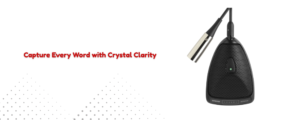
What The “Top Boundary” Means
When audio engineers record drums, the “top boundary” is the highest point where mics are placed above the drum kit. Most of the time, these mics are used to record the whole drum kit, including the snare, toms, and sometimes even the kick. In the room, they sound like your ears. If they don’t sound good, the drum sound will be bad too. Some engineers also use boundary microphones for drums to complement overhead mics, especially when capturing the natural room tone or enhancing the stereo image. These mics can be placed on floors or walls to pick up reflections and add depth to the overall drum recording.
The Top Edge Changes Several Things About the Sound of the Drum:
- Audio Picture: A bigger and more realistic audio spread is achieved with higher settings.
- Phase Relationships: Getting farther away from the kit can help keep the phase straight between close mics and overheads.
- Room Sound vs. Kit Sound: The higher the mics, the more room you pick up. This is good for ambient styles but could get muddy in unheated rooms.
- Cymbal Balance: Putting the cymbals too close together can make them stand out too much and miss the rest of the kit.
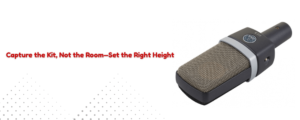
The Best Height For Overheads Is
Where is the Sweet Spot?
Engineers often put ceiling mics about 3 to 4 feet (0.9 to 1.2 meters) above the drums. After that, you can change based on the sound you want, the room, and the kit.
Overheads That Are Close (2–3 Feet Above the Drums)
- Pros: The drums are loud and punchy, and you have more control over the kit.
- Cons: The toms and drums may sound far away or off-center, and the stereo image may be small.
- Best for: Tight pop, rock, or studio settings where the sound of the room is kept to a minimum.
Medium Height (3 to 5 Feet Above the Drums)
- Pros: The sound from the whole kit is balanced, and there is good audio spread.
- Cons: A little more room bleed; gain staging needs to be done carefully.
- Best for: Indie, R&B, and jazz, among other styles.
High Overheads (5–7 Feet or More Above the Drums)
- Pros: It records the whole kit as a single instrument and has a huge, natural room sound.
- Cons: There is more background noise, and the drums can sound far away or washy.
- Best for: Orchestral, atmospheric, or live sounds in cleaned rooms.
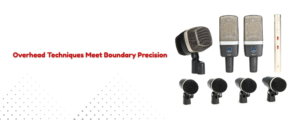
What Are Overhead Techniques and How Do They Work in Top Boundary
There is a close connection between the height and style of overheads. These are some common overhead methods and how they work with the idea of a top boundary:
1. Pairs Spaced
Each side of the kit has two condenser mics, one on the left and one on the right.
- It grows best at middle to high levels.
- Great sound picture, but phase problems can happen if you sit too close.
2. XY (Coincident Pair)
Two microphones are arranged close to each other in the shape of an X.
- Due to tight phase alignment, it works well at lower heights.
- Less room noise and more direct catch of the cymbals.
3. ORTF
With 17 cm between them, two mics are set at an angle of 110 degrees.
- A natural audio picture with a lot of depth.
- Most of the time, medium height works best.
4. Glyn Johns
There is a mic above the snare and another to the drummer’s right, above the floor tom.
- It works well at a height of 3 to 4 feet.
- If you do it right, it captures kit balance nicely.
Things That Affect Ceiling and Overhead Height
- Low Ceilings: You can only go so high in these rooms because the roof is low. Watch out for mirrors.
- Room Treatment: A room that has been treated lets higher mics work without picking up noise or echoes you don’t want.
- Music Style: Jazz and ensemble music need more background noise, while rock and pop music needs more direct, sharp mics.
- Style of Playing: Hard-hitters need more space for their sounds to breathe. Closer miking might help players who aren’t very loud.
Final Thoughts: Test, Listen, and Adjust
There’s no one-size-fits-all method for setting overhead mics when recording drums. A solid starting point is around 4 feet above the cymbals—but ultimately, your ears should guide the placement. Test different heights, listen closely, and adjust based on what the mix needs rather than what looks technically perfect. For enhanced depth and spatial realism, many engineers pair overheads with boundary microphones for drums, which are often placed on walls or floors to capture room reflections and energy. Additionally, experimenting with PZM mics for drum kits and the best floor mics for drums can help capture low-end resonance and natural reverb, making your kit sound more lifelike and balanced. When used in combination with thoughtful drum recording techniques, these tools give you greater control over atmosphere, punch, and stereo image—unlocking the full sonic potential of your kit.
As audio technology evolves, staying connected with trusted gear developers and communities can help engineers stay ahead. Whether you’re exploring new mic configurations or upgrading studio equipment, collaborating with reliable industry players—like those connected through initiatives such as the 5 Core Business Partnership Program—can provide access to innovations that enhance your craft without compromising your creative vision.