

When you want to mic a drum kit, one of the most important choices you have to make is between dynamic and condenser mics. Different types have different pros and cons. Knowing these differences will help you get the best sound from your drums. Picking the right mic type can make a big difference in how well you record the depth, attack, and sound balance of your drum kit, whether you’re recording in a studio or playing live. Find out which type of microphone is best for drumming by looking at the differences between dynamic and condenser mics.
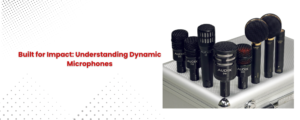
Understanding Dynamic Microphones
A lot of people use dynamic microphones for drums because they last a long time and can handle high sound pressure levels (SPL). A diaphragm connected to a coil in a magnetic field makes these mics work. The coil moves when sound waves hit the diaphragm. This makes an electrical signal that is turned into music.
Advantages of Dynamic Microphones for Drums
- High SPL Handling: The snare and kick drums, in particular, make sounds that are loud and change quickly. These very high SPLs won’t distort when used with dynamic mics.
- Durability: Dynamic mics are made to be used in rough situations, like live shows and professional studios.
- Tighter Pickup Pattern: The polar pattern of most dynamic microphones is either cardioid or super-cardioid. This helps separate the sound they are recording while blocking out unwanted noise.
- Affordability: In general, dynamic microphones are less expensive than condenser microphones.
Best Applications of Dynamic Mics for Drums
- Snare Drum: The Shure SM57 is a standard dynamic mic that is used for snare drums because it can pick up clear attacks and block out unwanted bleeding from other drums.
- Kick Drum: The AKG D112 and the Shure Beta 52A are models that are made to handle the low-end punch of a kick drum.
- Toms: For Toms, the Sennheiser e604 and Audix D2/D4 are great microphones that give off strong middle tones.
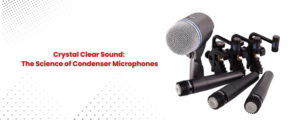
Understanding Condenser Microphones
In condenser mics, the diaphragm is placed close to a charged backplate, which makes a capacitor. When the diaphragm shakes, it causes electrical changes that are turned into an audio output. These mics can pick up a wider range of frequencies and are much more responsive than dynamic mics.
Advantages of Condenser Microphones for Drums
- Higher Sensitivity: Condenser mics capture more detail and nuance, making them ideal for picking up the subtleties of cymbals and room ambiance.
- Wider Frequency Response: These microphones can reproduce a broader range of frequencies, making them excellent for overheads and room mics.
- Crisp and Clear Sound: The extended high-frequency response of condensers allows them to capture the shimmer and clarity of cymbals and hi-hats.
- Better for Studio Use: Since condenser mics capture more detail, they are often preferred in controlled studio environments where sound bleed and excessive volume can be managed.
Best Applications of Condenser Mics for Drums
- Overhead Mics: Small-diaphragm condenser mics like the Neumann KM184 or AKG C451B are excellent for capturing the full kit’s natural balance and cymbal articulation.
- Room Mics: Large-diaphragm condensers such as the AKG C414, 5Core Drum Mic or Audio-Technica AT4040 are great for adding depth and ambiance to drum recordings.
- Hi-Hats: A small-diaphragm condenser like the Shure SM81 or AKG C214 helps capture the brightness and detail of hi-hats.
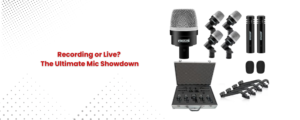
Dynamic vs. Condenser: Which One Should You Use?
Optimal use of dynamic or condenser microphones for drums is determined by application, environment, and desired sound.
Live Performance
Dynamic microphones are the go-to for live applications because they’re more robust and less likely to feedback and can handle higher SPL than their condenser counterparts. Since live environments can have considerably more dynamics and unwanted noise, particularly at silly rock volumes that might get picked up on a mic, we’d want to use dynamic mics that can isolate individual drums and minimize stage bleed. A dynamic mic on snare, kick and toms with a pair of overhead condensers can work well.
Studio Recording
In a studio setting, you can achieve a professional sound using a combination of both dynamic and condenser microphones. You’re using dynamic mics on the snare, kick, and toms to give it punch and attack; condensers on the overheads and hi-hat and as room mics for clarity, depth, and space.
Hybrid Approach
While many engineers and drummers take a hybrid approach — dynamic microphones are used on close-miked drums (snare, toms, kick) and condenser microphones for overheads and room ambiance. This combo offers the best of both worlds- the punch and tight pickup of a dynamic mic and the clarity and natural feel of condensers.
Conclusion
In the end, your needs and setting will determine whether you should use a dynamic or condenser microphone for your drums. Dynamic microphones are the best choice if you need something that will last, keep noise out, and handle high SPL. Condenser mics, on the other hand, are the best way to get clear, natural-sounding sounds with a wide frequency range. Most of the time, a mix of the two will give you the most professional and well-balanced sound. You can get the best drum sound whether you’re setting up for a live show or working in the studio if you know how to use these mics correctly.