
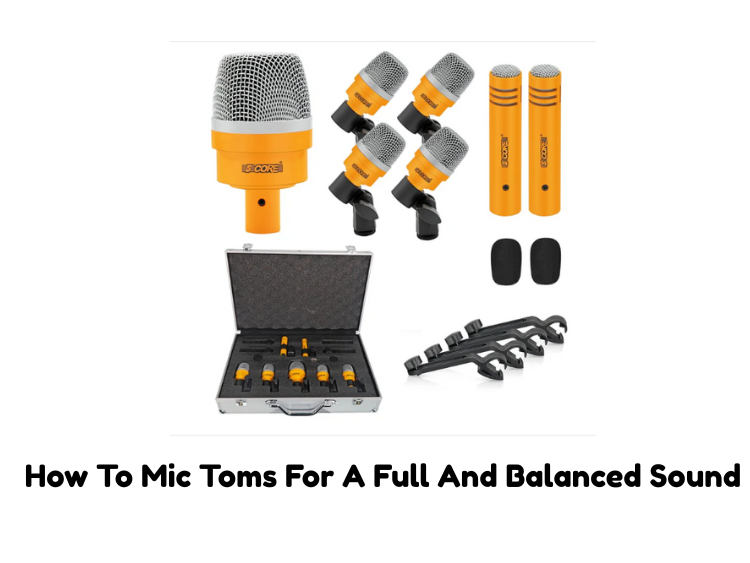
To get the best tom sound, you need the right microphone, the right place for it, and knowledge of how your drum kit sounds. Getting a full and balanced tom sound can make a big difference in your overall drum mix, whether you’re recording in a studio or getting ready for a live show. This guide will show you the best ways to record toms at a professional level, including the best mics to use and where to put them.
Choosing the Right Microphone
Getting the mic right is critical before getting into placement. Toms are low-end, midrange, and high-end instrument all rolled into one, so the mic has to be able to “see” a wide frequency spectrum.
Dynamic Mics
Most notably, it is used for toms that can withstand high SPL (sound pressure levels) and accentuate a natural, robust sound. Popular options are from brands such as Shure, Sennheiser, and AKG.
Condenser Mics
Deliver higher fidelity and wider frequency response, making them best suited for toms in the studio. They’re a little better at picking up more bleed from cymbals.
Clip-On Mics
Good for live performances, it clips right onto the drum rim to minimize mic stands on stage. Brands like Audio-Technica, 5Core, AKG, and Sennheiser make solid clip-on options.
Microphone Techniques for Tom
Close-Miking for Punch and Isolation
Yet the most common method on toms is close miking since it produces a tight, contained tone with little bleed. To achieve this:
- Mic 1 to 3 inches above the drumhead, angled about 45 degrees deep into the center.
- Placing it closer gives you more attack and less room sound, while moving it just behind the instruments lets some resonance through.
- One note of caution with drum mic placement, especially with a large diaphragm condenser — Avoid placing the mic directly at the point where the stick hits the drum surface, as that can give a lot of attack and a not particularly tonally friendly sound.
- Give rack toms some off-center mic placement so that you have a bit of attack and a bit of sustain. Placing the mic closer to the edge on floor toms produces extra low-end resonance.
All Natural Sound with Overhead Mics
Close miking captures both attack and body, while overhead microphones give a balanced sound to toms with an added largess.
- Hang your overheads 3 to 4 feet over the kit pointed down.
- A spaced pair (left and right) gives you a wide stereo image, while an XY setup is very good for minimizing phase issues.
Under-Miking for Added Depth
To get a fuller tone, some engineers put a second mic underneath the tom, adding resonance and sustain. This one works great with floor toms, in particular.
- Use a dynamic or condenser mic 2–4 inches below the drum and angle the mic toward the center.
- Invert the phase on this mic to prevent phase cancellation with the top mic.
Room Mics for Extra Ambience
So to lay down the toms in a more open, natural way, you can place some room mics further from the kit.
- Place room mics 6–10 feet away from the drum kit for a round of ambient sound.
- Depending on your room size and the acoustics, you may adjust their height and the distance.

Handling Mic Bleed and Phase Problems
Since tom mics are close to other drums and cymbals, bleed control is important. Here’s what to do about it:
- Cardioid or hyper-cardioid microphones reject sound from the sides and focus on the toms.
- Wherever you place them, orient the foils so their null points are facing the loudest nearby sources (i.e., the hi-hat).
- If you mic a bunch of toms, be sure to listen in mono so you can flip the phase on one of the mics if necessary.
Get That Perfect Sound With Processing
After the toms are properly miked, some fundamental processing improves their tone:
- EQ: Low-end mud rolloff (sub 60 Hz on rack toms, sub 40 Hz on floor toms). 5 kHz boost for attack, 100-200 Hz boost for warmth.
- Compression: Apply light compression to balance dynamics, fast attack, and medium release.
- Reverb: A small room or plate reverb will help add depth without letting the toms get washed out.
Conclusion
A balanced, full-tom sound requires the right mic choice, placement, and processing. Using either dynamic, condenser, or clip-on mics, the ideal results come from experimenting with angles and distances. Using bleed control, phase checking, and post-processing, you can ensure that your toms sound punchy, clear, and professional in any mix.