
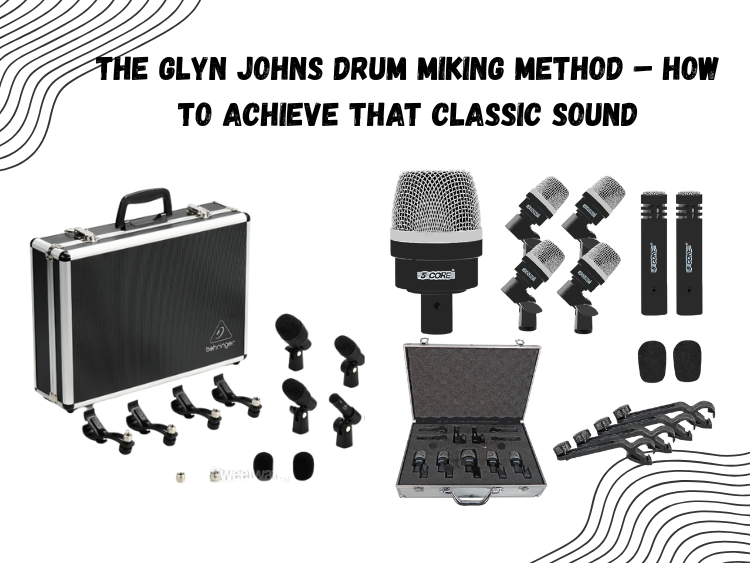
In a world of multi-mic drum recordings, there’s something beautifully raw about the Glyn Johns technique. Named after the legendary engineer who recorded the likes of Led Zeppelin, The Rolling Stones, and The Who, this method captures the kit in a way that feels wide, punchy, and incredibly musical—all with just three or four mics.
Forget the overkill. You don’t need 12 inputs and hours of phase correction to make drums sound huge. What you need is smart placement and a deep respect for natural acoustics.
So, What Is the Glyn Johns Technique?
At its core, the Glyn Johns method uses two condenser mics to capture the overhead image of the drum kit, with a third mic on the kick and sometimes a fourth on the snare.
The magic lies in the placement of the two overheads:
- Mic 1 (Overhead): Placed directly above the snare, about 3–4 feet up, pointing straight down.
- Mic 2 (Side/Over-the-Floor-Tom): Positioned just to the drummer’s right, pointing across the toms toward the snare.
The key here? Both mics must be the exact same distance from the snare to maintain phase alignment. This creates a tight, centered snare image while giving you a rich stereo spread of the toms and cymbals.
Toss a kick mic in front of the bass drum, and maybe a close snare mic if needed, and you’ve got a mix-ready drum sound that feels honest and three-dimensional.
Why It Works: Simplicity Meets Cohesion
Most modern recordings suffer from mic clutter. Too many mics, too many phase issues, and a drum sound that feels more like pieces stitched together than one cohesive performance.
The Glyn Johns method avoids this entirely. It treats the kit as a single instrument rather than a collection of individual parts. The result? A vintage drum sound with warmth, air, and punch—especially when recorded in a live room with decent acoustics.
And here’s the kicker: this setup forces you to make better musical decisions. You’re not getting lost in endless EQ tweaks. You’re committing to a sound at the source—like pros used to do.
Setting Up Your Mics
Here’s a practical, step-by-step breakdown to get you started:
- Set Up the Overhead Mic
Place your first mic about 3–4 feet above the snare drum, pointing straight down. This captures the snare, toms, and cymbals with a nice, balanced tone. - Position the Side Mic
The second mic should sit just past the floor tom, angled back toward the snare. It usually hovers 6–8 inches above the floor tom height, but this depends on your kit and room. - Measure the Distance from the Snare
Use a tape measure or a piece of string—make sure both mics are exactly the same distance from the center of the snare. This step is non-negotiable. Phase alignment makes or breaks this setup. - Add a Kick Mic
Use a dynamic mic or a large-diaphragm mic just outside the bass drum hole. Want a tighter low-end? Move it closer. More boom? Back it off a bit.
Optional: Add a Snare Mic
Not always necessary, but if you want a bit more snap, a snare mic can help. Just blend it in lightly.
Using something like the 5 Core 7-piece drum microphone kit gives you all the flexibility you need to try out variations of this method—without needing to buy separate mics for every drum.
What Kind of Sound Should You Expect?
Think big, open, and natural. The Glyn Johns method doesn’t isolate drums—it lets them breathe. You get the sense of the whole kit being played by a real person in a real space.
The cymbals shimmer without overpowering. Toms sound wide and round. The snare sits dead-center, balanced between both overheads. And if you’re in a room with good reverb, the kit sounds like it’s sitting in the mix, not slapped on top of it.
It’s no coincidence this was the go-to approach on Led Zeppelin IV—just listen to “When the Levee Breaks.”
Common Mistakes to Avoid
- Skipping the measurement step – If those overheads aren’t equidistant from the snare, your stereo image will feel off and phasing will eat your tone alive.
- Too close to cymbals – Back the mics off a bit. You want the full kit, not just sizzling highs.
- Overprocessing – Don’t squash it with compression or over-EQ. The charm is in the natural tone.
Ignoring room acoustics – This method thrives in open, lively rooms. If you’re in a tight space, you may need to experiment with positioning or throw up some room treatment.
Is It Right for You?
If you’re after that raw, vintage character and you’re tired of lifeless, overproduced drum mixes, give this method a shot. It’s ideal for rock, blues, indie, and even jazz—basically, any genre where feel trumps perfection.
Even if you’re working in a home studio or on a budget, this technique delivers pro-level results with minimal gear. A well-placed kick mic from this set and two decent overheads is all you need to tap into that punchy, retro vibe.
Final Word
The Glyn Johns drum miking method isn’t just a throwback—it’s a practical, effective, and sonically rich approach that still holds up in today’s recordings. It forces you to think in terms of space, tone, and performance, rather than isolated frequencies and endless plugins.
Try it out on your next session. You might be surprised at how three mics can do what twelve couldn’t.