
Hip-hop drums aren’t about subtlety. They’re about feel. That heavy, chest-thumping kick. The snare that slices through the mix. The crisp hi-hats that give it movement. And while a lot of that comes from programming, when you’re recording live or hybrid drums for trap, boom-bap, or drill—it all starts with the mic setup.
Whether you’re layering real drums under samples or going full acoustic in the studio, miking your kit the right way is key to nailing that signature hip-hop low-end and bounce. Here’s how to do it.
Start With the Kick – Your Foundation
Every genre leans on the kick, but in hip-hop, it’s everything.
You’re looking for something that punches, not just thumps. You want weight down low but with just enough attack to cut through basslines or 808s.
Mic placement is make-or-break here.
- Inside the kick drum, place a dynamic mic a few inches from the beater. This captures the attack.
- Outside the resonant head, throw a second mic (if you’ve got it) to capture the body and boom.
This gives you options in post: blend for punch or boost one side depending on the track.
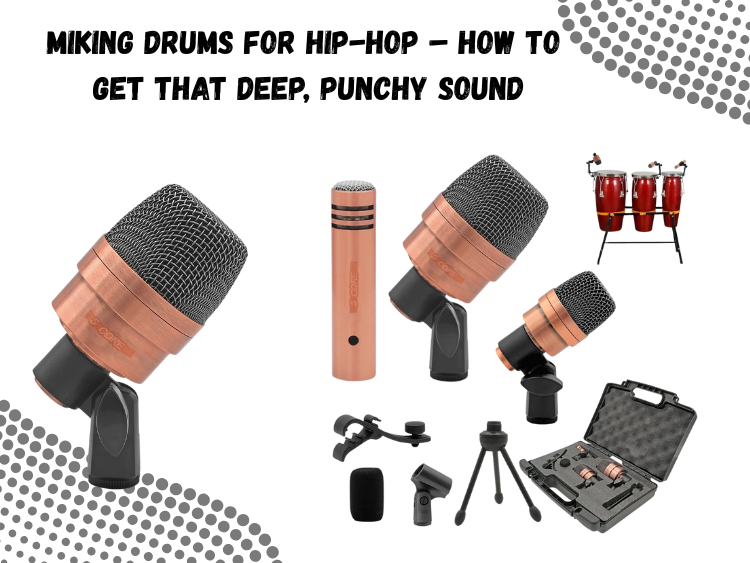
The 5 Core Condenser Drum Mic is perfect for this. It’s tuned to capture low-end detail without getting muddy—ideal for hip-hop kick tracking where clarity and depth need to live in the same space.
Snare – Snap + Grit
Your snare needs to hit hard. Not just volume-wise—it needs attitude.
Whether you’re after a tight trap snap or a roomy boom-bap crack, placement and mic choice matter. A dynamic mic angled just off-center from the top head usually gets you that balance of attack and body.
But here’s the trick most engineers skip: mic the bottom head too. That’s where the sizzle lives. The rattle. The raw grit that makes a snare feel alive.
Blend the top and bottom mics in your DAW, high-pass the bottom track, and you’ll get a snare tone with texture—one that can stand up next to layered claps or synthetic hits without disappearing.
This is where the 5 Core condenser mic shines again. It’s compact, clips right onto the drum, and captures both snare body and buzz without introducing noise. For hip-hop tones that mix acoustic and electronic layers, that precision makes all the difference.
Hi-Hats and Cymbals – Clean, Not Harsh
Hip-hop doesn’t usually need bright, washy cymbals like a jazz or rock mix does. In fact, too much top-end can make a mix feel messy real fast.
So you want clarity, not splash.
Use a small diaphragm condenser mic positioned 4–6 inches above the hi-hat, slightly angled to avoid direct blast. Keep it tight and focused.
For trap-style hats with rapid 32nd-note rolls, compress the signal lightly and gate it to keep things clean. You want that tick-tick-tick without the bleed from nearby drums.
If you’re using live rides or crashes in boom-bap tracks, overheads should be minimal—just enough to capture air and space. Otherwise, don’t overdo it.
Toms – Optional but Powerful
Not every hip-hop track needs toms. But when they do show up—think Kanye-style fills or old-school Tribe records—they need to hit low, wide, and clean.
Mic each tom individually if you’re tracking a full kit. Dynamic mics work best here for isolating punch.
But for studio sessions where space and time matter, a well-placed stereo overhead pair can do the job. Just make sure you’re rolling off anything below 100Hz to prevent overlap with the kick.
Again, the 5 Core condenser set gives you flexible mounting and clean pickup for toms, snares, and whatever else you throw at it.
Blending Live Drums with Samples
Let’s be real—most hip-hop productions are hybrid.
You’re stacking a live snare with a layered clap. You’ve got an 808 under the acoustic kick. Maybe you’re running chopped samples with a real ride loop on top.
That’s where a tight mic setup becomes your best friend. You don’t want to fix phasing issues in post. You want clean, isolated takes that let you blend without headaches.
Use gates to keep bleed out. Compress individual channels, not just the bus. And always leave headroom when tracking—your samples are likely already processed, so your raw kit needs to fit around them, not compete.
The 5 Core Edge
Here’s the thing: not all drum mic kits are built for hip-hop. Some are too bright. Others too muddy. What you need is a clean, punch-focused set with tight frequency response and zero fluff.
The 5 Core Drum Mic Kit checks every box—low-profile design, studio-ready condenser clarity, and rugged mounts that let you focus on the groove, not gear failure.
Whether you’re layering kicks, building organic loops, or going full live-trap, this set lets you lock in that deep, punchy tone without endless tweaking.
Wrap-Up
Hip-hop drum recording isn’t about mic’ing everything and hoping it sticks. It’s about intention. You need precision—on the kick, on the snare, and on the details that bring your beat to life.
The right mic placement and a solid kit like the 5 Core condenser drum set give you that raw, mix-ready tone right out of the gate.
So don’t settle for flat, lifeless takes. Dial it in, hit record, and let your drums punch through like they’re meant to.